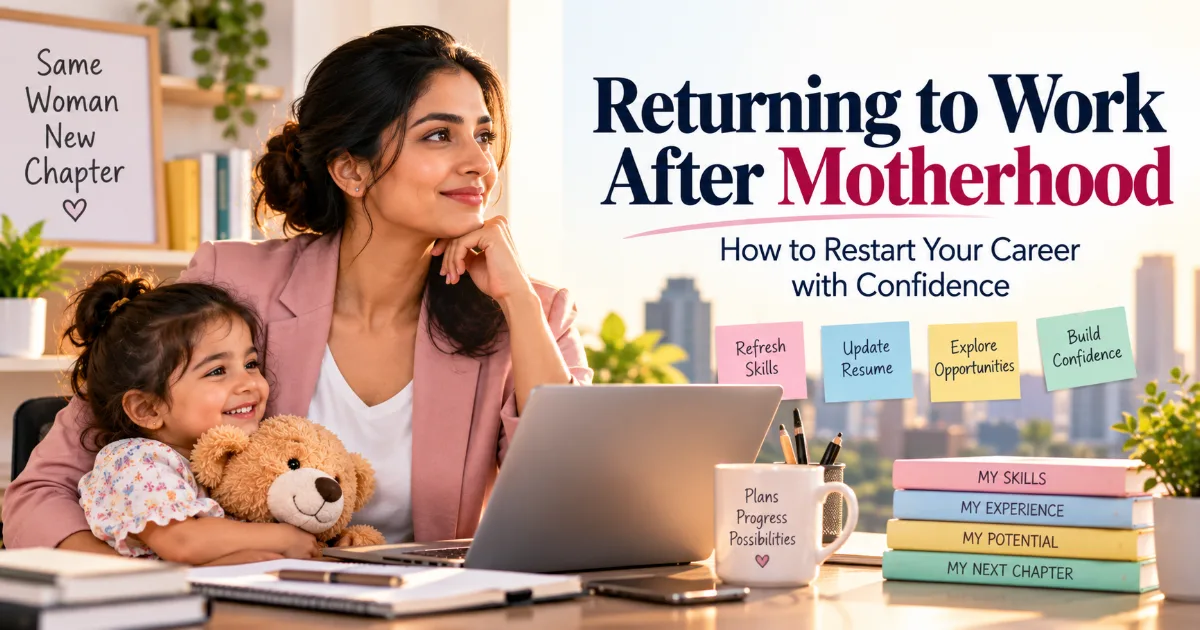

Motherhood is one of the most beautiful experiences in a woman's life, but it can also bring changes that are difficult to explain to someone who has never experienced them. Along with the happiness of welcoming a child comes a new set of responsibilities, sleepless nights, emotional challenges, and countless decisions. For women who have professional ambitions, motherhood can introduce another question: How do I continue building my career while giving my child the love, time, and attention they deserve?
Many mothers find themselves caught between two important parts of their identity. They want to be present for their children, celebrate their milestones, and create a loving home. At the same time, they want to grow professionally, achieve financial independence, develop their skills, and pursue dreams they may have worked towards for years. Sometimes, society makes these desires appear contradictory, as though choosing a career means compromising on motherhood or prioritizing family means giving up personal ambitions.
But the truth is that being a mother and having a career are not opposing choices. They are two parts of a woman's life that can coexist, even if balancing them requires time, support, patience, and a willingness to redefine success.
The Guilt That Many Working Mothers Experience
One of the most difficult challenges working mothers face is guilt. A mother may feel guilty when she leaves her child to go to work, and she may feel equally guilty when she takes time away from her professional responsibilities to care for her family. When she concentrates on an important project, she may wonder whether she is missing precious moments with her child. When she chooses to stay home for a family responsibility, she may worry about falling behind at work.
Continue Reading
This constant emotional conflict can become exhausting, especially when a woman feels that she must prove herself in every area of her life. The pressure becomes even greater when people around her question her decisions or compare her parenting choices with those of other mothers.
It is important to understand that feeling guilty does not necessarily mean that you are doing something wrong. Sometimes, guilt simply reflects how deeply you care about the people and responsibilities that matter to you. However, caring about your child does not mean you must abandon your personal goals, and caring about your career does not make you a less loving mother.
Children need love, security, attention, and a dependable support system. They also benefit from seeing the adults who care for them pursue meaningful goals, overcome challenges, and continue learning. A mother who works can be deeply involved in her child's life, just as a mother who stays at home can have her own ambitions and aspirations.
Instead of measuring motherhood by the number of hours spent together or professional success by how quickly you climb the career ladder, consider the quality of your relationships, the sustainability of your routine, and the happiness you experience in your different roles.
Your Career Is Still a Part of Your Identity
Before becoming a mother, you may have had dreams of leading a team, starting a business, becoming an expert in your field, earning a promotion, or building something of your own. These dreams were meaningful because they reflected your interests, abilities, and aspirations. Becoming a mother does not erase those parts of you.
Your identity can expand with motherhood without losing the person you were before it. You can love your child deeply and still enjoy solving professional problems. You can look forward to spending time with your family and still feel excited about an important project. You can be proud of your child's achievements while continuing to work towards your own.
There may be periods when your career takes a slower path because your family needs more of your attention. There may also be seasons when you have greater opportunities to focus on professional growth. These changes do not mean that you have failed or lost your ambition. They are part of navigating a life in which priorities can change over time.
If you have taken a career break, remember that a pause in employment does not erase your experience, knowledge, or potential. Skills developed through previous work remain valuable, and the patience, organization, adaptability, and problem-solving abilities strengthened through parenting may also support your professional life.
You do not need to prove your worth by achieving everything at once. Your career can develop at a pace that respects your circumstances while keeping your long-term goals alive.
Finding a Balance That Works for Your Family
There is no single formula for balancing motherhood and a career. Every family has different financial circumstances, childcare arrangements, working hours, responsibilities, and support systems. What works for one mother may not be practical for another.
For some women, a full-time job offers financial security and professional fulfillment. Others prefer part-time work, remote employment, freelancing, consulting, or entrepreneurship because these options offer greater flexibility. Some mothers decide to focus on childcare for a particular period and return to work when their circumstances change. Each of these choices can be valid when it reflects the family's needs and the woman's own informed preferences.
The important thing is to make decisions based on your actual circumstances rather than unrealistic expectations or pressure from others. Start by identifying the responsibilities that genuinely require your attention, the tasks that can be shared, and the activities that can be simplified or postponed.
Planning your week can help you identify time for work, childcare, household responsibilities, rest, and personal interests. However, planning should not become another standard you use to judge yourself. Children can become ill, meetings can run late, and unexpected responsibilities can disrupt even the most carefully organized schedule. Flexibility is just as important as planning.
A sustainable routine is not one in which every hour is perfectly managed. It is one that allows you to respond to changing needs without constantly feeling that your entire life is falling apart.
The Importance of Asking for Support
Many mothers are expected to manage childcare, cooking, cleaning, appointments, family schedules, and professional responsibilities as though they should be able to handle everything independently. Even when they have a partner, the responsibility for remembering and organizing household tasks can fall disproportionately on them.
This invisible workload can make balancing work and motherhood much harder than it appears from the outside. A mother may finish her paid workday only to begin another shift of household planning and childcare. Without meaningful support, exhaustion can gradually replace the excitement she once felt about her career.
Asking for help is not a sign of weakness. It is a practical way to create a healthier family environment. Partners can share childcare and household responsibilities rather than simply offering occasional assistance. Family members may be able to help with school pickups, meals, or appointments. Reliable childcare arrangements can give mothers the time and peace of mind needed to concentrate on their work.
Support also means having honest conversations about responsibilities, expectations, finances, and future plans. If one partner's career is consistently prioritized while the other's ambitions are postponed indefinitely, the arrangement may need to be reconsidered.
A family works best when the well-being and aspirations of its members are treated as important. Mothers should not have to earn the right to pursue their goals by first demonstrating that they can manage every household responsibility without help.
Returning to Work After a Career Break
Returning to work after motherhood can feel intimidating. You may worry that your industry has changed, your skills have become outdated, or employers will question the gap in your resume. You may compare yourself with former colleagues who have continued progressing professionally and wonder whether you can catch up.
These concerns are understandable, but they do not have to determine your future.
Begin by reviewing your existing skills and identifying the areas in which you would benefit from additional learning. Depending on your profession, this might involve updating your technical knowledge, completing a short course, developing a portfolio, or becoming familiar with new tools and working methods.
Reconnect with former colleagues, mentors, and professional contacts. Let people know that you are exploring opportunities and explain the kind of work you would like to pursue. Professional relationships can help you discover openings, understand industry changes, and regain confidence in your abilities.
When preparing your resume, present your previous experience clearly and focus on your achievements, responsibilities, and transferable skills. You do not need to apologize for taking time away from employment to care for your family. If asked about the career gap, provide a brief, confident explanation and direct the conversation towards your readiness and suitability for the role.
You can also explore returnship programs, flexible positions, contract work, and freelance projects where available. These options may provide a practical route back into professional life while allowing you to evaluate the arrangements that best suit your family.
Most importantly, give yourself permission to be a beginner again in some areas. Rebuilding professional confidence takes time, and you do not have to know everything on your first day back.
Teaching Children the Value of Independence and Ambition
Children learn from what adults tell them, but they also learn from what they observe every day. When they see their mother working towards a goal, managing challenges, learning new skills, and treating others with respect, they gain an example of determination and independence.
They can learn that work is one way people contribute to society, that financial independence matters, and that personal development can continue throughout life. They can also learn that family responsibilities are shared and that caring for others is not limited to one person in a household.
This does not mean every mother must work outside the home to set a positive example. A mother who chooses to stay home also demonstrates valuable lessons through her work, decisions, and relationships. The central lesson is that a woman's worth is not defined by a single role or by whether she follows someone else's expectations.
Children benefit when they grow up understanding that people can have multiple responsibilities and that success can take different forms. They can learn that ambition and compassion can coexist, that asking for help is sensible, and that mistakes are opportunities to learn.
You do not have to create a perfect life to teach these lessons. Your willingness to keep trying, communicate honestly, and care for yourself and your family can be meaningful in its own right.
Do Not Forget Your Own Well-Being
When a woman becomes a mother, her own needs can easily move to the bottom of the priority list. She may postpone rest, ignore her interests, avoid meeting friends, or feel uncomfortable spending money and time on herself. Over time, this pattern can leave her emotionally and physically exhausted.
Self-care does not have to involve expensive holidays or elaborate routines. It can mean getting enough rest whenever circumstances allow, taking a short walk, speaking to a trusted friend, reading something you enjoy, or spending a little time on a personal interest.
It can also mean recognizing when your responsibilities have become overwhelming and seeking practical or professional support. Persistent exhaustion, distress, or feelings of hopelessness deserve attention rather than being dismissed as an unavoidable part of motherhood.
Your well-being matters independently of how much you accomplish for other people. You are not simply a mother, an employee, a partner, or the person who keeps the household running. You are also an individual with feelings, interests, hopes, and needs.
Taking care of yourself is not a rejection of your family. It is part of building a life in which you can care for others without continually neglecting yourself.
Redefining What Success Looks Like
Society often presents success through visible achievements such as promotions, salaries, business growth, academic qualifications, and professional recognition. Motherhood, meanwhile, is frequently judged through expectations about a child's behavior, household routines, school performance, and the amount of time a mother spends with her family.
Trying to satisfy every expectation can make a woman feel that she is always falling short somewhere.
A healthier approach is to define success according to your own priorities and circumstances. For one mother, success may mean returning to a full-time role after a long break. For another, it may mean building a small business that provides financial independence and flexible working hours. Someone else may choose to spend several years focusing primarily on raising children before exploring new professional opportunities.
Your definition of success may also change as your children grow, your financial circumstances evolve, or your interests develop. That is normal. You are allowed to reassess your priorities without treating every change as a failure.
There will be days when your work goes well and family life feels difficult. There will be days when your family receives your full attention and your professional plans move more slowly. These experiences do not cancel each other out. They are part of a life in which different responsibilities require attention at different times.
You do not need to achieve perfect balance every day. You need a way of living that is sustainable, meaningful, and aligned with what matters most to you.
Final Thoughts
Motherhood can change your priorities, routines, relationships, and understanding of yourself, but it does not require you to abandon your dreams. You can be deeply devoted to your children while continuing to develop your skills, pursue professional opportunities, and work towards financial independence.
The journey will not always be easy. Some days will demand difficult choices, and some seasons will require you to slow down. There may be moments when you question your decisions or feel that you are not doing enough. During those moments, remind yourself that you are navigating several important responsibilities in a world that does not always provide mothers with the support they need.
You deserve a family life in which responsibilities are shared, a workplace where your contributions are valued, and a future in which your aspirations still have room to grow.
You do not have to choose between being a good mother and being an ambitious woman. You can define motherhood on your own terms, build a career at your own pace, and create a life that respects both your family and your individuality.
Your dreams did not become meaningless when you became a mother. They simply became part of a bigger story, one in which your growth matters too.
#MomAndCareer #WorkingMoms #MotherhoodAndCareer #WomenInTheWorkplace #CareerAfterMotherhood