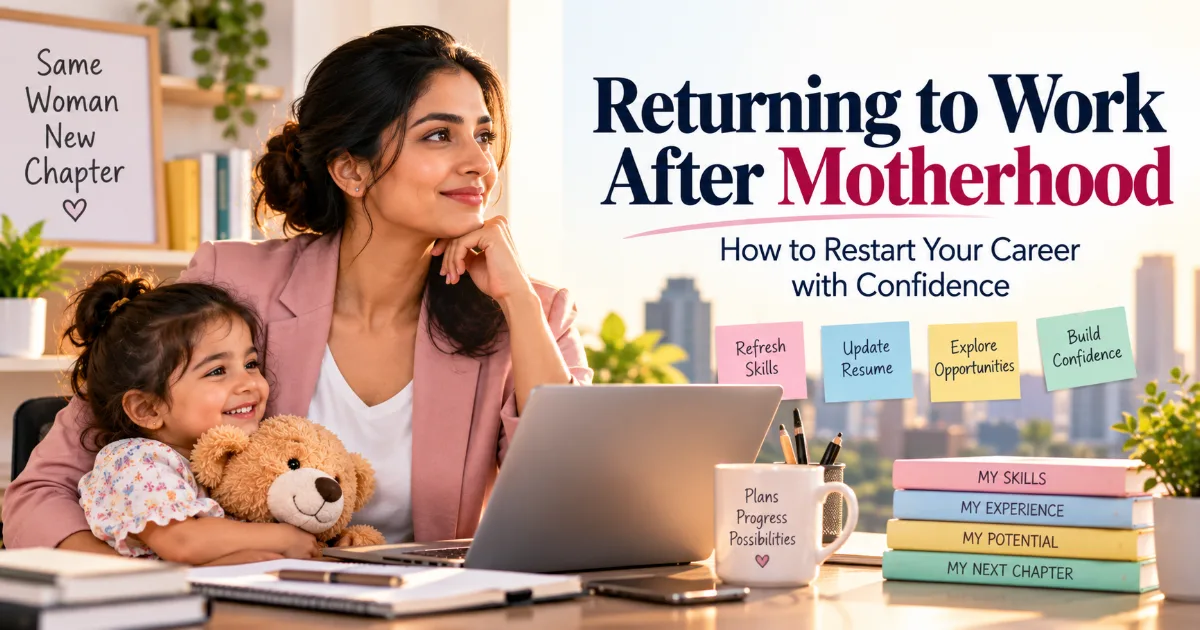
Becoming a mother changes a woman's life in countless ways. Priorities shift, routines change, and responsibilities increase. For many women, these changes lead to a career break that lasts several months or even years. During this period, they may devote their time and energy to raising their children, managing family responsibilities, and adjusting to a completely new chapter of life. Although motherhood can be deeply rewarding, the thought of returning to professional life after a long break can feel overwhelming.
Questions begin to arise. Will employers consider my application after such a long gap? Have my professional skills become outdated? Will I be able to manage work and family responsibilities together? What if younger candidates have more recent experience? These concerns can make the process of returning to work feel more difficult than it needs to be.
However, taking a career break does not mean that your professional journey has ended. Your previous experience, knowledge, talents, and ambitions still matter. You may need time to rebuild your confidence, refresh your skills, and find the right opportunity, but your career can begin a new chapter.
Returning to work after motherhood is not about becoming the person you were before having children. It is about understanding who you are today, recognizing the skills you already possess, and building a professional future that fits your current circumstances.
Continue Reading
Understanding Your Fears Before Taking the First Step
One of the biggest challenges of returning to work is often the fear of rejection. After spending years away from a professional environment, a woman may begin to question her abilities. She may look at job descriptions and feel that she no longer meets the requirements, even when she has relevant qualifications and experience.
Sometimes, this lack of confidence develops gradually. A woman who once handled important projects, managed teams, or worked independently may begin to believe that her career achievements belong to the past. She may hesitate to apply for positions because she assumes that employers will reject her as soon as they notice the employment gap.
It is important to distinguish between an actual skills gap and a lack of confidence. If your industry has introduced new technologies or working methods, you may need to update your knowledge. That is a practical challenge that can be addressed through learning. If you are avoiding applications because you believe that motherhood has made you less capable, the challenge may be more about how you see yourself.
You do not need to feel completely confident before beginning your job search. Confidence often develops through action. Updating your resume, completing a course, speaking with former colleagues, and applying for suitable roles can help you gradually regain trust in your abilities.
Instead of asking whether you are still as capable as you were before your career break, ask what you can do today to prepare for the next opportunity.
Identify Your Career Goals Before Applying for Jobs
Before sending out applications, take time to understand what you want from your professional life. Returning to work simply because you feel pressured to do so may lead you towards opportunities that do not suit your interests, financial needs, or family circumstances.
Start by reviewing your previous professional experience. Consider the roles you enjoyed, the responsibilities you handled well, and the skills that made you feel confident. Think about whether you want to return to the same industry, explore a related field, or develop a completely new career.
Your priorities may have changed since you last worked. Perhaps you previously accepted long working hours because professional growth was your primary focus. Today, you may value predictable schedules, flexible working arrangements, or a shorter commute. These preferences do not make you less ambitious. They reflect your current responsibilities and the way you want to organize your life.
It is also worth considering your financial goals. You may want to contribute to household expenses, rebuild personal savings, support your child's education, or become financially independent. Understanding your priorities will help you identify opportunities that offer genuine value rather than accepting the first available position.
Write down your short-term and long-term goals. Your immediate objective might be to return to employment within the next six months, while your longer-term goal could be to move into a leadership role or establish your own business. Having a direction makes it easier to decide which skills to develop and which opportunities deserve your attention.
Update Your Skills and Knowledge
Workplaces evolve quickly, and the skills required for a role may change during a career break. Depending on your profession, new software, industry standards, communication tools, or technical methods may have become common. Preparing for these changes can improve your confidence and help you compete for relevant positions.
Begin by reviewing job descriptions for the roles you would like to pursue. Look for skills that appear repeatedly and compare them with your existing knowledge. This exercise can help you identify what employers expect and where you may need additional preparation.
You do not necessarily need to enroll in an expensive degree program. Short courses, practical projects, professional workshops, and structured self-learning may be enough to refresh your knowledge in certain fields. Choose learning opportunities that are relevant to the jobs you want rather than collecting certificates without a clear purpose.
If you work in technology, you might need to refresh your programming knowledge, understand current development tools, or build a small project demonstrating your abilities. If you work in marketing, you might review digital marketing platforms, content analytics, and current campaign practices. If your background is in finance or administration, updating your knowledge of commonly used software and reporting methods may be useful.
Practice matters as much as learning. Completing a project, creating a portfolio, or solving realistic professional problems can help you demonstrate that you are ready to contribute.
Remember that you do not have to learn everything before applying. Focus on the most important skills, continue improving as you progress, and avoid allowing preparation to become a reason to postpone your career indefinitely.
Build a Resume That Highlights Your Strengths
A career gap can make resume writing feel uncomfortable, particularly when you are unsure how employers will interpret the period away from work. The best approach is to present your professional background clearly, honestly, and confidently.
Start with your previous work experience and achievements. Highlight projects you completed, responsibilities you managed, improvements you contributed to, and results you helped deliver. Whenever possible, describe your accomplishments in specific terms rather than listing only routine duties.
Your resume should focus on the value you can bring to an employer. If you previously managed customer relationships, coordinated projects, analyzed data, supervised employees, or developed technical solutions, make those capabilities easy to identify.
You generally do not need to explain every personal detail associated with your career break. If you choose to mention that you took time away from work for caregiving, keep the explanation brief and professional. Your resume is primarily a document that demonstrates your qualifications and suitability for a role.
If you have completed courses, certifications, freelance assignments, volunteer projects, or other relevant activities during your break, include them when they strengthen your application. Do not invent work experience or present informal activities as paid employment. Instead, describe your actual contributions accurately.
Consider adapting your resume for each position. A role that emphasizes project coordination may require a different selection of achievements from one that focuses on technical expertise or customer service. A carefully tailored resume can make your relevant experience more visible.
Most importantly, do not apologize for your employment gap. Your career history is one part of your professional story, not a complete measure of your ability or potential.
Prepare a Confident Explanation for Your Career Break
Employers may ask about your career gap during an interview. Preparing a clear answer can reduce anxiety and help you handle the conversation professionally.
You do not need to provide a lengthy personal explanation. Acknowledge the break, explain that you stepped away to manage family responsibilities if you are comfortable sharing that information, and move the conversation towards your readiness to return.
For example, you could explain that you took time away from employment to focus on family responsibilities and are now prepared to resume your professional career. You can then describe the steps you have taken to refresh your skills and the reasons you are interested in the position.
The goal is not to convince the interviewer that your career break was an achievement in itself. The goal is to demonstrate that you have relevant experience, understand the requirements of the position, and are prepared to perform the work.
Avoid speaking about your career gap as though it were something shameful. Equally, avoid making promises about availability or working hours that you cannot realistically maintain. A sustainable professional arrangement depends on honest communication from the beginning.
Practice your explanation before the interview. When you become comfortable discussing your career break, you are less likely to become defensive or allow the subject to dominate the conversation.
Explore Different Ways to Return to Work
Returning to work does not always require securing a full-time position immediately. Depending on your qualifications, financial circumstances, and childcare arrangements, several pathways may help you re-enter professional life.
Full-time employment can be suitable for mothers who want a stable salary, structured responsibilities, and a clear path for professional advancement. Part-time work may provide a gradual transition for women who need more flexibility while adjusting to a new routine.
Freelancing and consulting can offer opportunities to use existing skills on individual projects. These arrangements may be particularly useful for professionals in writing, design, software development, accounting, marketing, research, and other fields where work can be delivered on a project basis. However, income may fluctuate, and finding clients requires time and effort.
Remote employment can reduce commuting time and offer greater flexibility in some roles. Nevertheless, working from home does not automatically make it easier to care for a young child while meeting professional deadlines. Reliable childcare and a suitable working environment may still be necessary.
Some organizations offer returnship programs designed for professionals who have taken career breaks. These programs may include training, mentoring, and structured opportunities to demonstrate workplace readiness. Availability and eligibility vary, so research individual programs carefully.
You may also consider entrepreneurship if you have a business idea, marketable skills, and a realistic understanding of the financial and operational responsibilities involved.
There is no single correct route back to employment. The most suitable option is one that aligns with your abilities, financial needs, family responsibilities, and long-term ambitions.
Rebuild Your Professional Network
Professional networking can be valuable when returning to work, particularly if you have been away from your industry for several years. Former colleagues, managers, mentors, classmates, and professional acquaintances may help you understand current hiring practices and identify suitable opportunities.
Begin by reconnecting with people you already know. You do not need to ask everyone for a job. A simple conversation about your professional interests and plans can help reopen relationships that have been inactive for some time.
Update your professional profile to reflect your experience, skills, and current goals. Share relevant professional insights, participate in industry discussions, and connect with people working in fields that interest you.
If you are uncertain about how your industry has changed, consider requesting a brief informational conversation with someone who has recent experience in your target role. Ask about the skills employers value, common hiring expectations, and areas where additional learning may be helpful.
Networking should not become a source of comparison or pressure. Seeing former colleagues advance in their careers may sometimes be discouraging, but their circumstances and responsibilities may differ from yours. Use professional connections to gather information and explore opportunities rather than measuring your progress against someone else's timeline.
You can rebuild your network gradually. A few meaningful conversations may be more useful than hundreds of superficial connections.
Find an Employer That Respects Your Responsibilities
A successful return to work depends not only on finding a job but also on finding a workplace where you can perform well without facing unreasonable expectations about your personal life.
During the hiring process, learn about the organization's working hours, leave policies, flexibility arrangements, performance expectations, and approach to professional development. If flexibility is important to you, consider asking how the team manages schedules, deadlines, and occasional personal responsibilities.
It is also useful to understand whether the role requires regular travel, late meetings, or frequent overtime. These requirements may be manageable for some families but difficult for others.
You do not need to disclose every detail of your family life during an interview. However, you should understand the practical requirements of the role and decide whether they fit your circumstances.
Look for workplaces that evaluate employees according to their contributions, skills, and performance rather than assumptions about their family responsibilities. A supportive manager and a clear working arrangement can make a significant difference to your experience.
At the same time, remember that flexibility does not eliminate professional accountability. Meeting commitments, communicating early when difficulties arise, and maintaining the quality of your work remain important.
The objective is to establish a working relationship in which both you and your employer understand the expectations and can plan accordingly.
Plan Childcare and Household Responsibilities
One of the most practical challenges of returning to work is organizing the responsibilities that previously occupied your working hours. Before accepting a position, think through how childcare, school schedules, household tasks, commuting, and unexpected situations will be managed.
Discuss these arrangements with your partner or other family members who will be involved. Identify who will handle morning routines, school drop-offs, meals, appointments, and emergencies. If you use paid childcare, research the available options and consider their reliability, cost, and suitability for your child.
Try to establish backup arrangements for situations such as a child's illness, childcare cancellations, or changes in work schedules. No plan can prevent every disruption, but having alternatives can reduce stress when something unexpected happens.
Household responsibilities may also need to be reorganized. Simple meal planning, shared calendars, advance preparation, and dividing chores fairly can make everyday routines more manageable.
Avoid assuming that you must continue doing everything you did before returning to work. If your available time decreases, some tasks may need to be simplified, delegated, or completed less frequently.
Your home does not have to operate perfectly for your career to succeed. What matters is creating a workable routine that protects your family's well-being and allows you to meet your professional commitments.
Manage Rejection Without Losing Confidence
The job search may involve rejection, unanswered applications, and interviews that do not lead to offers. These experiences can be discouraging, particularly when you are already concerned about returning after a career break.
However, rejection does not automatically mean that your employment gap is the problem or that you are no longer capable of succeeding professionally. Hiring decisions depend on many factors, including specific skills, experience, competition, organizational needs, and the suitability of candidates for a particular role.
After an unsuccessful application, review what you can learn from the experience. If you are repeatedly being rejected before interviews, examine whether your resume clearly communicates your qualifications and matches the positions you are targeting. If interviews are not leading to offers, practice explaining your experience, discussing relevant examples, and answering role-specific questions.
Seek constructive feedback when it is available, but do not expect every employer to provide a detailed explanation. Continue improving your approach while recognizing that some outcomes are outside your control.
Set realistic goals for your job search. You might dedicate specific hours each week to applications, networking, skill development, and interview preparation. A consistent routine can help you maintain momentum without allowing the process to consume every available moment.
Your first opportunity after a career break does not need to define the rest of your professional life. It can be a starting point from which you rebuild experience, regain confidence, and explore further opportunities.
Give Yourself Time to Adjust
Returning to work is a transition for the entire family, not just for the mother. You may need time to adjust to new schedules, professional expectations, childcare arrangements, and the emotional experience of spending less time at home.
During the first few weeks, you may feel tired or uncertain as you learn to manage these changes. This does not necessarily mean that your decision was wrong. It may simply mean that you are adapting to a new routine.
Pay attention to what is working and what needs adjustment. If your mornings are consistently stressful, prepare some things the previous evening. If you find it difficult to concentrate while working from home, consider whether a different schedule or more reliable childcare would help. If your workload is consistently unmanageable, discuss priorities and expectations with your manager where appropriate.
Avoid judging the success of your return to work by how smoothly everything goes immediately. Transitions take time, and routines often improve through experience.
Allow yourself to celebrate progress, including achievements that may appear small. Completing your first week, finishing a professional course, attending an interview, or successfully managing a new responsibility can all be meaningful steps forward.
You are building a new chapter, and it is reasonable to give yourself time to find your footing.
Conclusion
Returning to work after motherhood can bring uncertainty, but it can also create opportunities for personal growth, financial independence, and renewed professional purpose. A career break does not erase your qualifications, your previous achievements, or your ability to contribute to a workplace.
Start by understanding your goals, refreshing the skills relevant to your chosen field, preparing a strong resume, and reconnecting with your professional network. Explore different employment options, plan your family arrangements, and look for workplaces that respect your contributions and offer suitable working conditions.
You do not have to compete with the career timeline you might have followed before motherhood. Your circumstances have changed, and your path may look different now. That does not make it less valuable.
There may be challenges along the way, but every application, conversation, learning experience, and interview can help you move closer to your goal. Be honest about what you need, confident about what you can offer, and patient with the process of rebuilding your professional life.
Motherhood is an important part of your identity, but it does not have to be the end of your professional ambitions. You can care for your family while continuing to invest in your own future. Your experience matters, your skills still have value, and your next career chapter is worth pursuing.
#MomAndCareer #CareerAfterMotherhood #WorkingMoms #WomenReturningToWork #CareerBreak